I was forewarned as many of myfriends and well wishers were apprehensive when my Jordan trip was taking shape. ISIS, MiddleEastern violence, war, bombing, targeting innocent tourists, all the negative words that I didn’t want to hear, filled my ears. But my gut told me that the beautiful Jordan can’t be anything but safe, and it proved in the end, to be safer than any other place in the world, including our own India. I not only roamed there freely, but also fel at home, thanks to their warm, friendly and hospitable nature.
I reach Amman on a chilly morning, minus my baggage (partof International Travel). Eager tosee the much talked about HolyLand, I hop into a car with myguide Salah, travel 30 kms alongthe Kings’ Highway, to reach Madaba, the ‘City of Mosaics’. Bestknown for its spectacular Byzantine and Umayyad mosaics, Madaba is home to the famous sixth century Mosaic Map of Jerusalem and the Holy Land. With two million pieces of vividly coloured local stone, it depicts hills and valleys, villages and towns as far as the Nile Delta. Also within the area is Mount Nebo, one of the mostrevered holy sites of Jordan and the place where Moses was buried. Draped in a shrug, I shiver in thecold wind (as my heavier woolensare in the missing suitcase) andgaze at the ‘Promised Land’ Mosessighted eons ago. Later, we visit the Church of the Virgin and Archeological Museum that houses a treasure trove of mosaic masterpieces. Salah tells me that hundreds of such mosaics from the fifth and seventh centuries are scattered throughout Madaba’s churches and homes. I sign my name on a huge ongoing mosaic art work and click a picture of the same (for theFacebook, of course!!).
In Madaba, our lunch at ‘Haret Jdoudna’, a 20th century Turkish house with romantic courtyards converted to a charming restaurant, gives me the first glimpse into Jordan culture. Women clad in stylish heads carves and their peals of laughter filling the place with a positive energy prove the good amount of freedom Jordanian women enjoy.
The country is the land of mesmerising beauty and offers plenty of options for modern travellers
Suave and ultra chic Queen Rania of Jordan, the most admired and loved royalty today, reaches millions through the social media, penetrating into their hearts with her down to earth simplicity, compassion and a genuine wish to reach people. A role model for many youth, she sets an exampleof dynamic leadership combined with a modern approach. Onceback in Amman, I have the good fortune to meet her at the Royal Automobile Museum. In her address, she stresses the importance of human interaction during travel, calling travellers, ‘the bestambassadors for tolerance’. Shesays that they can help change the global perception of Arabs and Muslims, particularly during current times and tell the world that Jordan is a safe, warm, and a welcoming country.
Thus reassured, I continue my journey in Jordan and realise that Jordan is a land of mesmerising beauty and offers so much for a modern traveller like me.
Amman, the capital of Jordan, I find to be a fascinating city of con- trasts – a unique blend of old and new, ideally situated on a hilly area between the desert and the fertile Jordan Valley. Amman takes pride in its much older past.
Wandering among the Roman Ruins in the ancient city of Jerash, I learn that its unbroken chain of human occupation dates back more than 6,500 years. Jerash lies on a plain surrounded by hilly wooded areas and fertile basins. Conquered by General Pompey in 63 BC, it came under Roman rule and was one of the ten great Roman cities.
I roam freely in Wadi Rum, a stupendous, timeless place, virtually untouched by humanity. The huge monolithic rocks carved by the weather and winds rise up from the desert floor to great heights. I enjoy the warm hospitality of the semi-nomadic Bedouin people.
Petra, included in the ‘Wonders of the World’ (New List), is Jordan’s most valuable treasure. It is a vast, unique city, carved into the sheer rock face by the Nabataeans, an industrious Arab people who settled here more than 2,000 years ago, turning it into an important junction for the silk, spice and other trade routes that linked China, India and southern Arabia with Egypt, Syria, Greece and Rome.
The warm, soothing, super salty water of the Dead Sea, about ten times saltier than sea water, and rich in minerals, soothes my tired nerves as I float on the incredibly buoyant waters. No wonder, they have attracted visitors since ancient times, including King Herod the Great and the beautiful Egyptian Queen, Cleopatra. Dead Sea’s rich, black, stimulating mud rejuvenates my whole being.
Need I say I fully agree with Queen Rania’s statement that Jordan is a safe, warm, and welcoming country??
Fact File
How to reach : Ethihad, Emirates, Qatar, etc operate regular flights from all major Indian cities. Ensure that there is a minimum of 90 minutes lay over be- tween flights; otherwise luggage can be the missing. No fun in receiving your clothes at the end of your trip!!
Where to stay : Kempenski Ishatar- Dead Sea, Le Royal, Land Mark in Amman, Marriot in Petra etc
visa : On arrival. Costs 40 JD
Currency : JD (Jordanian Dinar= 87 to 90 INR)
Must Eat : Food is a major attraction with a wide vari- ety. Mansaf, Shahwarma, Zerb, etc just to name a few.
Must Drink : Limon Nana- a mint lemonade that can get addictive
What to buy : Jordan Mosaics come in all sizes and are very artistic. Also Tins of Hummus, perfumes (Ithar), baklava, dates, beautiful handicrafts made in Jordan, Syria, Egypt etc. Better have JD in hand rather than pay in American dollars and lose in the transaction
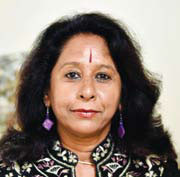
Vijaya Pratap is a freelance journalist and a documentary filmmaker, based in Hyderabad. She specialises in the study of art, culture, history and wildlife.
Meet the Author – Vijayapratap