

The land of picturesque hills and verdant landscapes, of brave head-hunters and fierce warriors, a receptacle of ancient traditions and stunning natural beauty, Nagaland seems like an enigma. But a closer look and a warm interaction dispel many a myth about the quiet, shy, yet very friendly people who love to tell stories about their deservedly proud state. A story seems to be hidden in every corner – from hunting legends to spiritual tales. I follow the story of Khonoma, India’s first ‘Green Village’. Located around 20 km from Kohima, Khonoma is a scenic village overlooking green paddy fields and surrounded by horizon-kissing forested hills. It’s home to the brave Angami Nagas, an indigenous warrior tribe.
My guide is Vibhu, an Angami inhabitant of the once “warrior village”. He starts with a story of how Khonoma’s fierce soldiers resisted the British time and again. And then he narrates, with great pride, the story of how the villagers launched a campaign for nature conservation. Traditionally, the villagers depended on the surrounding forests for livelihood. Between hunting, foraging and logging, the forest cover was being depleted drastically, even leading to
a fall in the numbers of the much revered pheasant, Blythe’s tragopan, Nagaland’s state bird. In 1998, the village elders decided to ban logging and hunting. A part of the forest was demarcated as the Khonoma Nature Conservation and Tragopan Sanctuary. Villagers became guardians of the green and members of the local bodies monitored conservation efforts. Over the years, the forest healed, wildlife was restored. Conservation became a part of everyday life in Khonoma.
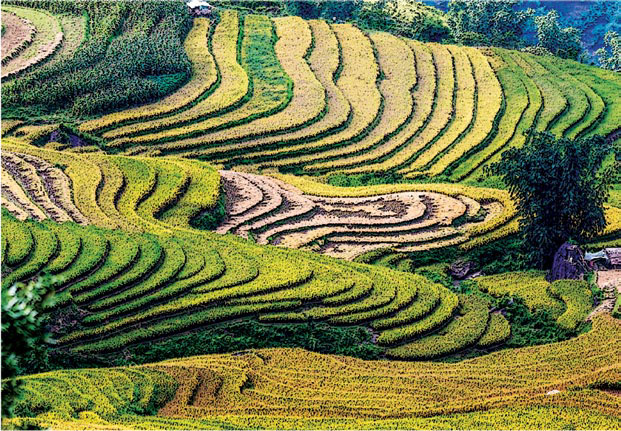
In the idyllic and spotlessly clean village, with flourishing kitchen gardens outside most houses, every drop of water is conserved and recycling is a habit. The villagers practice terrace farming, store water flowing down the hills in small reservoirs and their farm produce is entirely organic. We walk along a winding cobbled path lined with red poinsettias and wild lilies, as life leisurely goes on inside the rustic tin-roofed houses with mud floors and bamboo walls. Men and women with khophis (conical bamboo baskets) strapped to their backs, climb the stepped path effortlessly, carrying food and household goods. Others tend to animals, warmly when they spot tourists.
In the idyllic and spotlessly clean village, with flourishing kitchen gardens outside most houses, every drop of water is conserved and recycling is a habit. The villagers practice terrace farming, store water flowing down the hills in small reservoirs and their farm produce is entirely organic. We walk along a winding cobbled path lined with red poinsettias and wild lilies, as life leisurely goes on inside the rustic tin-roofed houses with mud floors and bamboo walls. Men and women with khophis (conical bamboo baskets) strapped to their backs, climb the stepped path effortlessly, carrying food and household goods. Others tend to animals, warmly when they spot tourists.
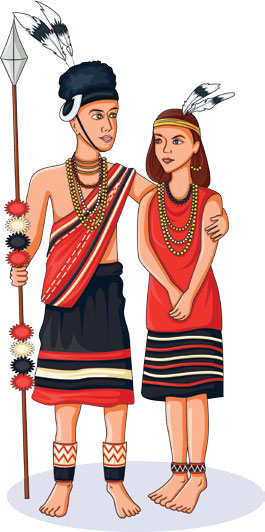
Some of the women practice traditional weaving, producing shawls in unique colours and designs. After they finish gathering food from the nearby forests and doing their daily chores, they assemble in a village common room, where looms have been setup with the help of a self help group, to weave. A shawl takes one full day to be completed and fetches around INR 500. I choose a pretty red and black one with tiny motifs of crossed spears woven at the ends and make friends with its makers, Ano and Atono.
The forests here are rich in bamboo and cane, hence the art of basket making is quite evolved. A wizened villager, Roko, who regales me with his battlefield stories, leads us to a morung (boys’ dormitory), where we find young men chatting and drinking zutho (a local rice beer resembling a porridge). Morungs are richly decorated traditional wooden houses with a pair of crossed swords on top, and are centres for spreading of moral values, education, art and crafts and for resolving disputes by village elders. Inside, on the walls are displayed various weapons, a legacy of the warring days.
It’s almost afternoon by the time I end my village tour and I pause for a bit by a bend, looking out over the terraced hills, the valley below and small houses set against the mountains. A sense of peace pervades and I wish I could carry this tranquility back with me they way I am doing their stories!
Also Explore
Dzukou Valley
Nagaland’s most popular and exciting trekking destination, the Dzukou Valley is surreal and spellbinding! Though it is gorgeous at any time of year, in early June the hills are bursting with the Dzukou lily and the flowering season peaks in the first two weeks of July. An hour’s drive from Kohima (35 km) will take you to Viswema, the starting point of the trek to Dzukou Valley, which goes through thick evergreen forests, stunning landscapes of dwarf bamboo and then a lush valley of flowers!
Dzuleke
A hidden gem, Dzuleke is a tiny village nestled beside a stream. Around 10 km from Khonoma, you can ideally have a picnic here or stay overnight in one of the home-stays. Here too the local Angami tribe residents have banned hunting to protect wildlife. Spot wild bisons grazing by clean mountain streams. Try fresh crabs from the Dzuleke river with aromatic binni rice.
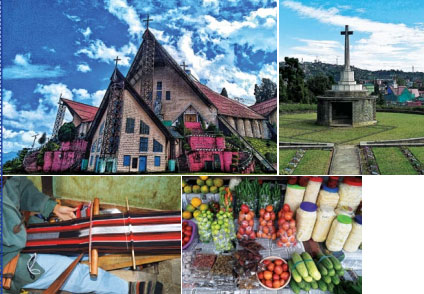
Kisama
Kisama Heritage Village (around 12 km from Kohima) gives a fair idea of life in a traditional Naga village. Here, each of the 16 major Naga tribes is represented by its characteristic morung. In December, it hosts the famous Hornbill Festival.
The Cathedral of Kohima
Built by the Japanese as a monument to Japanese soldiers who died in the Battle of Kohima during World War II, the massive hill-top church is noted for its architecture, which resembles a traditional Naga house. Catch a panoramic view of the Kohima city from the hill.
Kohima War Cemetery
A memorial dedicated to the British soldiers who died in WW II in Kohima, this site has 1,420 Commonwealth soldiers buried and also a memorial to 917 Hindu and Sikh soldiers.
Vijaya Pratap is a freelance journalist and a documentary filmmaker, based in Hyderabad. She specialises in the study of art, culture and wildlife.
Meet the author – Vijaya Pratap