
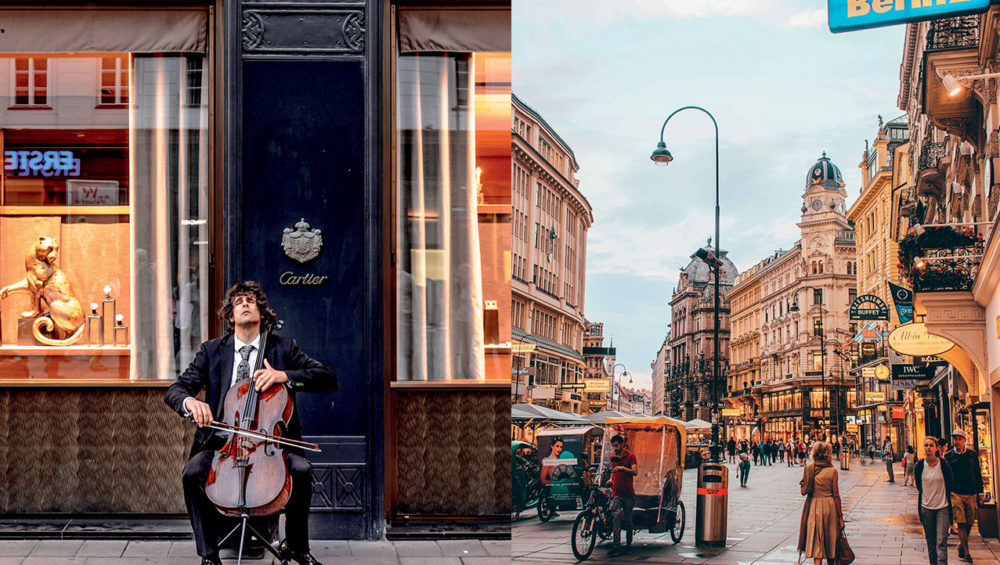
The overwhelming grandeur of Vienna amazes me as I drive to Hotel Gilbert in the Museum Quarter. An hour later I stroll in the Maria-TheresienPlatz: cast in bronze, the formidable figure of Empress Maria Theresa still commands all that is around her and beyond. Two magnificent buildings stand regally on either side, Kunsthistorisches (Museum of Art History) and the Natural History Museum Vienna; a handful of fountains and beautifully sculpted marble statues dot the green landscape. Basking in the warm evening sunshine, I admire the splendid environs, waiting to discover more.
The next morning, Tom, my guide, and I walk on the most beautiful Ringstrasse Boulevard, a masterpiece in terms of urban planning, that took 50 years to build. Starting with the Parliament, passing many imposing structures like the Austrian National Library (Heldenplatz), and through the 5.3km walk along Ringstrasse, Tom speaks of Vienna’s history, art, people, culture, and heritage, all of which make the city admirable. As a bonus, he waits patiently as I click tonnes of pictures.
Fun Fact
Snow globes, Erwin Perzy’s accidental creation, originated in Vienna. A magical world in miniature, my favourite one has snow quietly falling onto St. Stephen’s Cathedral and the Giant Ferris Wheel. The largest selection can be seen (and bought) at the Snow Globe Museum.
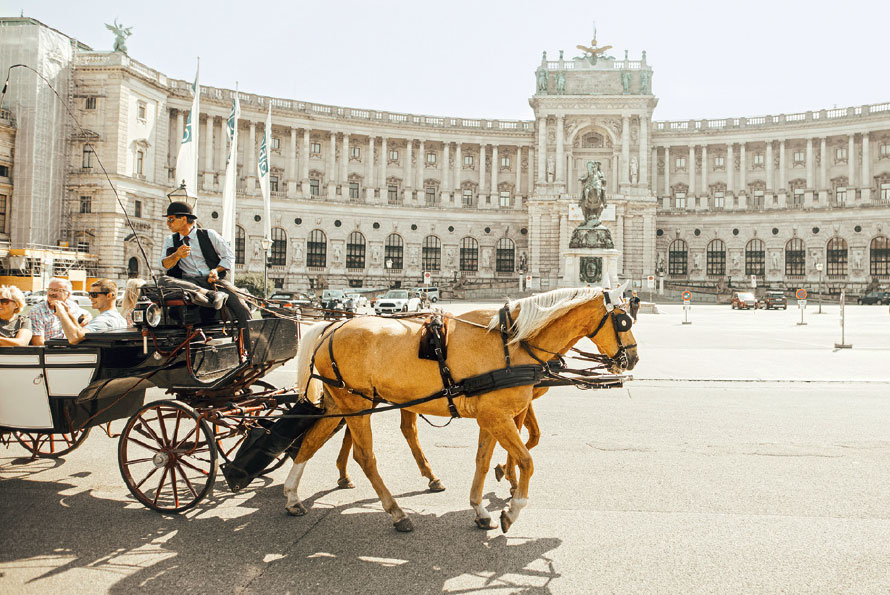
Walking down Kohlmarkt, a magnificent green dome comes into view followed by the majestic curved façade of The Hofburg (Imperial Palace), one of the biggest integrated palace complexes in the world that housed the
private apartments and stunning staterooms of the Habsburg royal family, that ruled for more than seven centuries. Now, it accommodates offices, museums, and the Spanish Riding School. This is the palace where Maria Theresa lived and ruled, where her 16 children were born and raised. In the Sisi Museum, there are more than 300 exhibits including Empress Elisabeth’s (aka Sisi) dresses, jewellery, stationery, art equipment, the harp from her childhood, etc.
With exquisitely-carved marble statues, each telling a story, and horse carriages plying in the historical palace complex, it looks like a scene from a period film. It might be a good idea toget the Vienna City Card, which gets you discounts in museums and tourist attractions, plus a 20 percent discount on room rates in participating hotels and restaurants, and a 24-hour Hop-On Hop-Off bus ticket. Walking along Graben, admiring some of the old buildings and their unique architecture, we walk past the iconic Plague Column and enter St. Stephen’s Cathedral, where I find the interiors and the organ music quite captivating. St. Charles Church, with its mighty green dome, is another important sacred building and a symbol of Vienna. Passing by the Albertina Museum, I am struck by the beauty of Danubius Fountain.
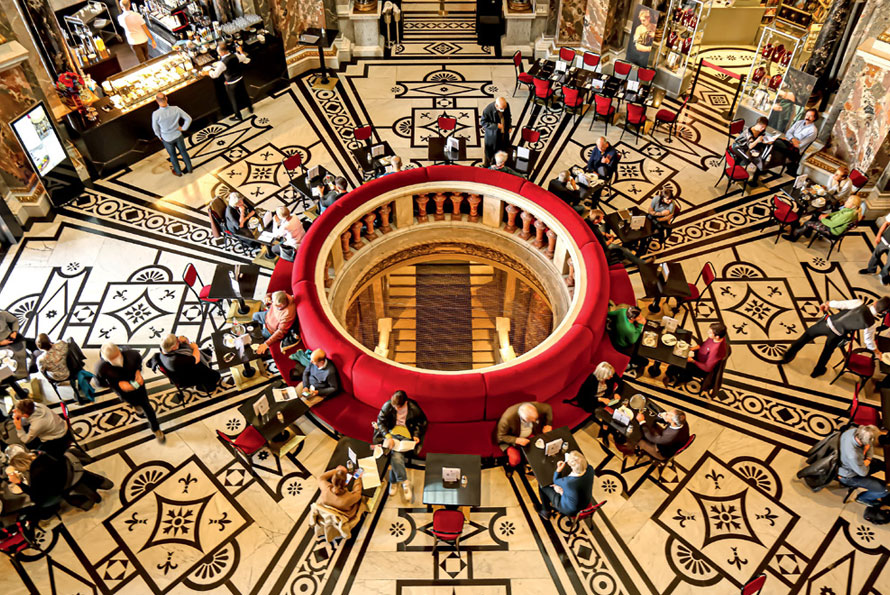
Lunch is at the classy Café Museum that opened in 1899 and became a meeting place for Viennese artists. Later, Tom gives me a tour of the spectacular Vienna State Opera. At the edge of the old town is Urania, a public educational institute in art nouveau style. That evening, we walk through Spittelberg to explore creative art, and dine at TIAN Bistro. All vegetarian and vegan dishes use resources from root to leaf (sourced from local organic farms). Viennese practise mindful eating as well as meaningful living!
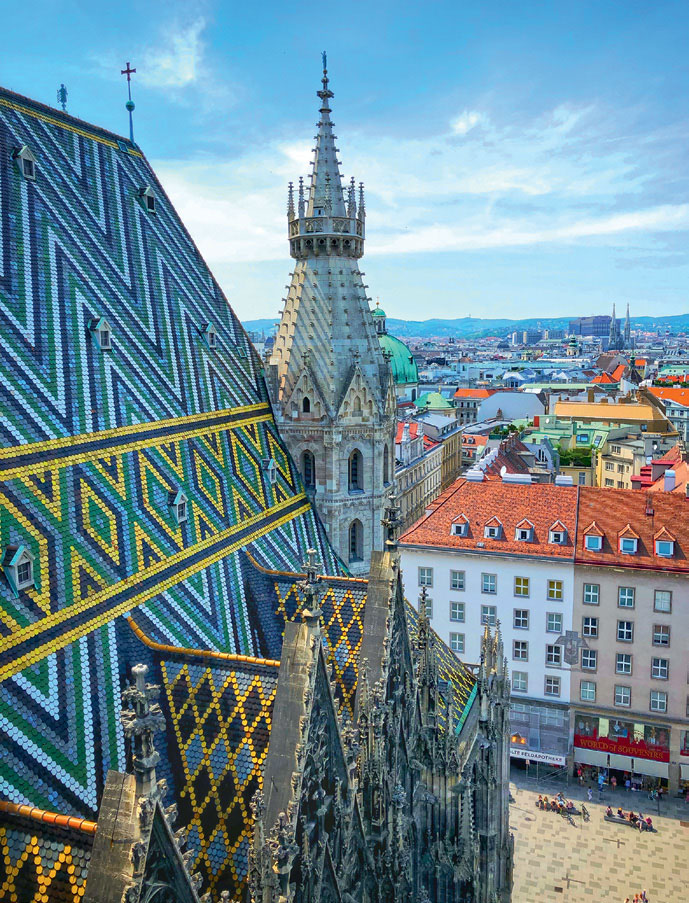
St. Stephen’s Cathedral is considered the most important religious building in Vienna; its multicoloured tile roof is one of the city’s most recognisable symbols
The next day, Tom takes me to Schönbrunn Palace, where more grandeur awaits: well-preserved objects from different parts of the world; themebased royal quarters, stunning gardens and gorgeous sculptures. In the Upper Belvedere Palace, the reflection pond mirroring the façade is a show-stopper! That evening, at the ‘Strauss and Mozart-Dinner Concert’ at Kursalon Hübner, my heart waltzes and pirouettes to the celebrated music. Vienna takes a bow with majestic grace!
5 MUST-VISIT CAFES
AIDA
INSIDER’S TIP
“The parks are the best way to get some fresh air between seeing the museums. My favourite is Volksgarten: it’s home to 400 varieties of roses—a spectacular sight in spring.”
Tom Bachinger – Licensed Tour Guide
Coffee with a dash of history. One of the city’s oldest coffee houses, it offers great views from the first floor. Stephansplatz 1010 Wien, Singerstraße 1; aida.at
CAFÉ BELLARIA
One of Vienna’s oldest traditional cafés, in a new guise. Offers allday dining. Bellariastraße 6, 1010 Wien; cafebellaria.at
CAFÉ BRÄUNERHOFF
The favourite café of literary greats. Hop over for Viennese delights and a large selection of newspapers. Right behind the Hofburg; Stallburggasse 2, 1010 Wien; +43 1 5123893
CAFÉ CENTRAL
Founded in 1867, the traditional café was a hotspot for philosophers and writers, including Sigmund Freud. Has a fabulous in-house patisserie. At the corner of Herrengasse and Strauchgasse; cafecentral.wien
CAFÉ DANIEL MOSER
A trendy bar on the site of Vienna’s first-ever coffee house, with a lineage that dates back to 1685 Rotenturmstraße 14, 1010 Wien; danielmoser.at
To Get Around: Take the U-Bahn (subway), the Schnellbahn or S-Bahn (local train), the Straßenbahn (tram) or ride the Autobus (bus).
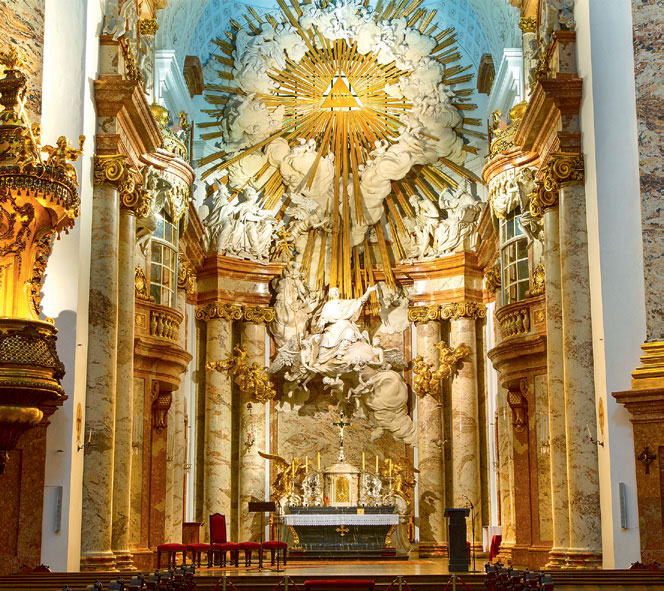
Borromäus, the
Karlskirche is considered a
fine example of Baroque
architecture
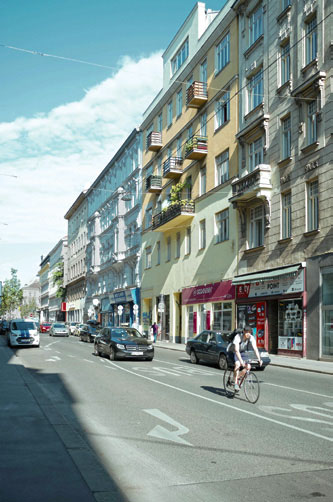
haven for biking and walking
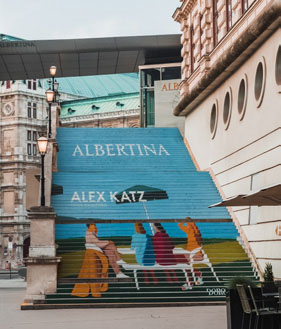
looking at the Albertina
Museum’s staircase.
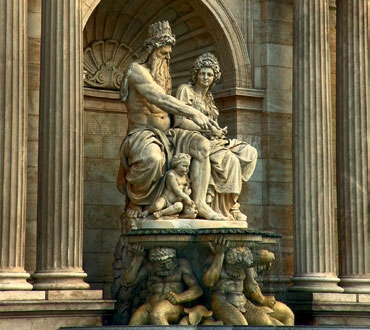
ornamental fountains such
as the Danubius Fountain,
outside the Albertina
Museum
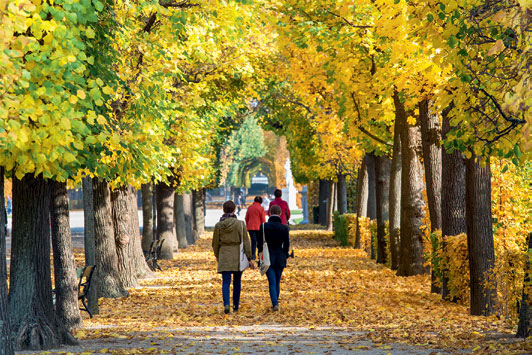
Schönbrunn Palace
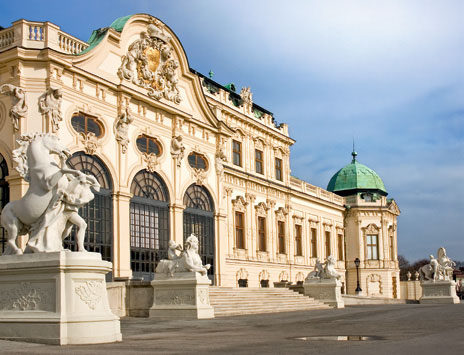
grand Belvedere Palace
Experience Vienna’s timeless elegance and rich culture through magnificent architecture, museums, historic cafés—and its music
Vijayapratap