The Arab world had always fascinated me: reading Arabian Nights as a child, studying world history as a student and peeping into a world of exotic fantasy in my later life as a traveller. I would often look out for familiar characters coming alive in the souks, in the narrow alleys and in the vast desert sands, mounted on lone camels.
I set out to Jordan, the Hashemite Kingdom that once captivated ancient travellers. Jordan’s capital, Amman, welcomed me warmly on a cold morning. My affable guide Salah Abunaffaa took me around, doling out valuable information sprinkled with wit. A sprawling city spread over 19 hills, tree-lined streets and avenues flanked by elegant white buildings, Amman was occupied by the Assyrians, Babylonians and Persians, and later conquered by the Greeks and renamed Philadelphia. The ruins on the Citadel Mountain lend an appealing charm to the modern city.
The city of mosaics
On my way to the Holy Land, I imagined the tall and ruggedly handsome Moses (read Charlton Heston) walking me through the pages of history, as we drove 30km from Amman, on the 5,000-year-old Kings’ Highway to reach Madaba. Besides spectacular Byzantine and Umayyad mosaics, Madaba houses the famous 6th century Mosaic Map of Jerusalem and the Holy Land. With two million pieces of vividly coloured local stone, it depicts hills and valleys, villages and towns as far as the Nile Delta.
Also within the area is Mount Nebo, one of the most revered holy sites of Jordan. As I gazed at the “Promised Land” that Moses sighted ages ago, I felt his saintly presence engulfing the hills. Later, in the Moses Memorial Church and Archaeological Museum I saw some micro-mosaic masterpieces. Salah told me that hundreds of stunning mosaics from the 5th and 7th centuries are scattered throughout Madaba’s churches and homes.
During our lunch at Haret Jdoudna—a 20th century Turkish house with romantic courtyards converted to a charming restaurant, I had my first glimpse into Jordan culture. Packed with women clad in stylish headscarves, their peals of laughter filling the place with a positive energy, I saw for myself the good amount of freedom Jordanian women enjoy.
Bethany beyond the Jordan
This is the place where early Christianity was born. The wooden roofed walking track leading to the baptism site in Bethany, lined with a profusion of bougainvillea was beautiful and made the long walk tireless. At the baptism site, the scene looked divine—a pond of water, steps leading to it, the remains of a church, all glowing in the bright afternoon sun. This is where Jesus was baptised by John the Baptist. This is also the place where Elijah is said to have ascended to heaven in a whirlwind.
We walked further to reach the narrowest part of Jordan river that divides Israel and Jordan. I saw on the Israel side, some people going through the baptism ritual that was being filmed, as the sonorous chants of the priests filled the air. The Greek Orthodox Church nearby with its golden dome made a pretty sight, lending beauty to the arid desert.
Dead Sea
The warm, soothing, super salty water of the Dead Sea, about 10 times saltier than sea water, and rich in minerals, soothed my tired nerves as I floated on the incredibly buoyant waters. No wonder, they have attracted visitors since ancient times, including King Herod the Great and the beautiful Egyptian queen, Cleopatra. Dead Sea’s rich, black, stimulating mud rejuvenated my whole being, prompting me to buy some Dead Sea beauty products later.
Jerash
As we entered Jerash, I saw hundreds of boisterous school boys on an excursion. They smiled and waved at me, some even struck a conversation in broken English. A few willingly posed for pictures and burst into laughter as I showed them the photographs. Some boys presented me with lovely red flowers growing on the rocks nearby.
The next two hours were spent in wandering among the Roman ruins in the ancient city of Jerash that boasts of an unbroken chain of human occupation for more than 6,500 years. A man on bagpipes and another on drums gave a short performance as some men danced and children clapped. Sameer, a 14-year-old school boy, recited a long poem in praise of King Hussein and King Abdullah. I felt close to all of them, participating in their display of love for their country, culture and their monarchy. The modern city of Jerash lies to the east of the ruins, trying to catch up with the rest of the world.
Wadi Rum
It is place virtually untouched by humanity. Carved by the weather and winds, the huge monolithic rocks rise to great heights in Wadi Rum. When I complained about the oppressive heat, driver Hasan good humouredly taught me, instead, to say “Ana baheb Sahara” in Arabic, meaning “I love Sahara”! But a gastronomic surprise was in store for me in the form of Zarb, which turned out to be my most memorable meal in Jordan. Cooked in an oven that is dug into the ground, the three-tiered tray held meat, rice and vegetables resulting in a rich, delicious feast.
Petra
Petra took me by surprise, in spite of watching many documentaries earlier. Included in the new list of the Wonders of the World, it is a vast, unique city, carved into the sheer rock face by the Nabataeans, an industrious Arab people who settled there more than 2,000 years ago, turning it into an important junction for the silk, spice and other trade routes that linked China, India and southern Arabia with Egypt, Syria, Greece and Rome.
Walking through the Siq, a narrow gorge over 1km long, flanked on either side by 80m-high cliffs, I was blown away by the dazzling colours and formations of the rocks. As I reached the end of the Siq and caught my first glimpse of Al-Khazneh (treasury) I was dumbstruck. A massive façade, 30m wide and 43m high, carved out of the sheer, dusky pink rock-face, dwarfed everything around it. It was carved in the early 1st century as the tomb of a Nabataean king. I went back many centuries and silently watched the treasure being secretly hidden by the king himself.
On a serious note, that awe-inspiring experience itself was the treasure that I found and it will stay with me forever—one of the greatest wonders ever wrought by nature and man.
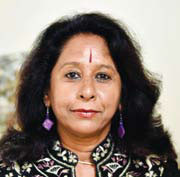
Vijaya Pratap is a freelance journalist and a documentary filmmaker, based in Hyderabad. She specialises in the study of art, culture, history and wildlife.
Meet the Author – Vijayapratap